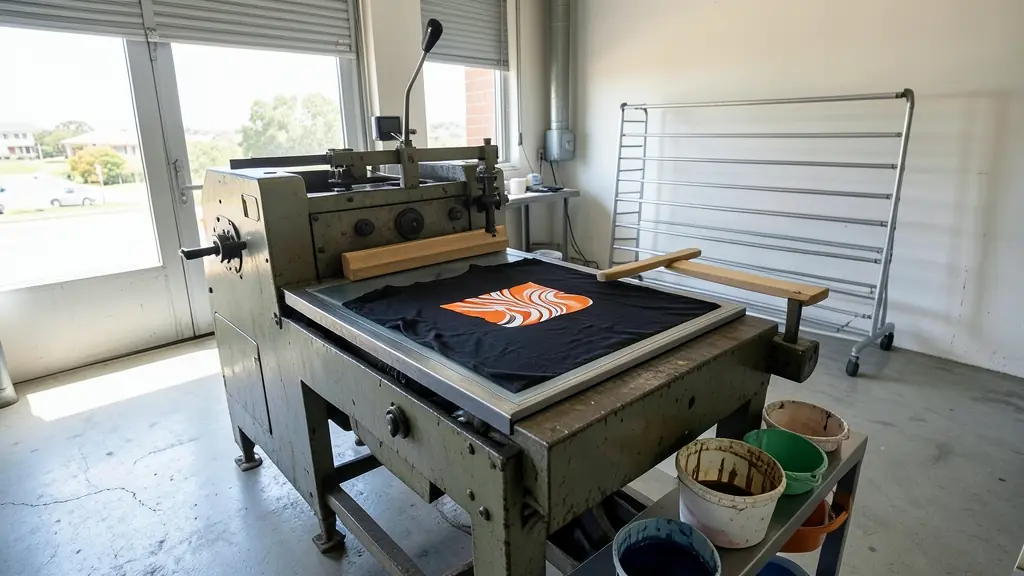
Screen printing pushes thick ink through a fine mesh screen onto the garment, one screen for each colour. It gives a strong, opaque print that survives hundreds of washes, and once the screens are made, every extra shirt is quick and cheap to print. That makes it the usual method for event shirts, staff wear, school kit, tote bags and merchandise runs of the same design. Tell us the item, the quantity, the positions and the colours, and we pass it to screen printers near you. The request is free and there is no obligation.
How screen printing works
Your artwork is split into colours, and each colour is burnt onto its own coated mesh screen. The printer lays one colour at a time, then cures the ink with heat so it bonds to the fabric. Common inks:
- Plastisol: bright, opaque and easy on dark shirts.
- Water based: soft feel on light cotton.
- Discharge: removes the dye for a soft print on dark cotton.
- Specials: puff, metallic and glow inks.
The same process prints bags, aprons and some promotional items.
When screen printing is the right choice
Screen printing pays when you print the same design on many items, usually from about 30 to 50 pieces upward. For a single shirt or a run with different names, DTF or vinyl is cheaper. Fewer colours mean fewer screens, so a bold one or two colour design is the cheapest. Dark garments often need a white underbase, which is an extra screen. Each extra position (back, sleeve) needs its own screens and its own print pass. Mixed sizes are fine, but very small and very large sizes may need a different print width.
Artwork for screens
Send vector artwork with each colour as a solid spot colour, not a photo. Fine detail below about 0.5 mm and soft gradients are hard to hold on a screen, though a printer can use halftones for shading. Give the print width and position. Ask for a test print or a sample garment. Common mistakes: sending a JPEG from a website, too many colours for the budget, and a design that is larger than the smallest shirt size. Cure matters: a well cured print does not crack or wash out, so ask how the printer cures the ink. For mixed methods on one order, see T-shirt printing.
What drives the price
Screens are a setup cost charged per colour, so the price per item falls as the run grows. Ask each screen printer:
- What is the screen fee per colour, and do they keep screens for reorders?
- What is the price per print at your quantity and number of colours?
- Are the garments included, and which weight?
- Is there a minimum, and is VAT included?
What to include in your request
- Quantity per design and the size run
- Garment or bag, colour and fabric
- Number of colours in each print
- Print positions and print width
- Whether screens are kept for reorders
Screen Printing for different clients
- Families and individuals: a batch of shirts for a big family wedding, reunion or a stokvel outing
- Small businesses and start-ups: merchandise shirts and totes for a brewery, a band or a market stall
- Companies and offices: bulk staff shirts for a product launch, a site safety week or a year end
- Shops, restaurants and salons: printed tote bags and staff tees in one design for every branch
- Events, conferences and clubs: hundreds of shirts in one design for a fun run, festival or cycle race
- Schools, churches and NGOs: house shirts, sports day tees and matric shirts printed in bulk
- Government and municipalities: awareness campaign shirts and bags for clinics, elections and municipal drives
- Designers, agencies and resellers: contract screen printing for clothing labels, promotional suppliers and agencies
Frequently asked questions
How much does screen printing cost per shirt?
What is the minimum order for screen printing?
Why does screen printing need one screen per colour?
Can I do silk screen printing myself at home?
Screen Printing by province and city
- Johannesburg
- Pretoria
- Centurion
- Midrand
- Sandton
- Randburg
- Roodepoort
- Krugersdorp
- Randfontein
- Germiston
- Boksburg
- Benoni
- Kempton Park
- Alberton
- Vanderbijlpark
- Vereeniging
- Durban
- Pinetown
- Pietermaritzburg
- Richards Bay
- Newcastle
- Ladysmith
- Gqeberha (Port Elizabeth)
- East London
- Kariega (Uitenhage)
- Mthatha
- Cape Town
- Bellville
- Paarl
- Stellenbosch
- George
- Worcester
- eMalahleni (Witbank)
- Middelburg
- Secunda
- Mbombela (Nelspruit)
- Rustenburg
- Brits
- Klerksdorp
- Potchefstroom
- Mahikeng
- Polokwane
- Tzaneen
- Kimberley
- Upington
- Bloemfontein
- Welkom
- Sasolburg